Signals and Systems#
Biological organisms are complex, organized systems. Merely listing their components - organs, cells, molecules - does not explain how they work. What truly matters are the interactions among these components. It is therefore not surprising that Systems Theory, a framework for describing and analyzing such interactions, has its origins in biology. Today, Systems Theory is applied far beyond biology, in disciplines ranging from physics and engineering to economics and the social sciences.
A central concept in Systems Theory is the black-box model. This model abstracts away the internal structure of a system (Fig. 1) and focuses instead on its input-output relationship: signals enter the box, are processed by some (possibly unknown) mechanism, and yield observable outputs.
Key insight
If a black box produces the same outputs for every possible input as the real system, then - for prediction purposes - the two systems are equivalent. This does not mean they are identical internally.
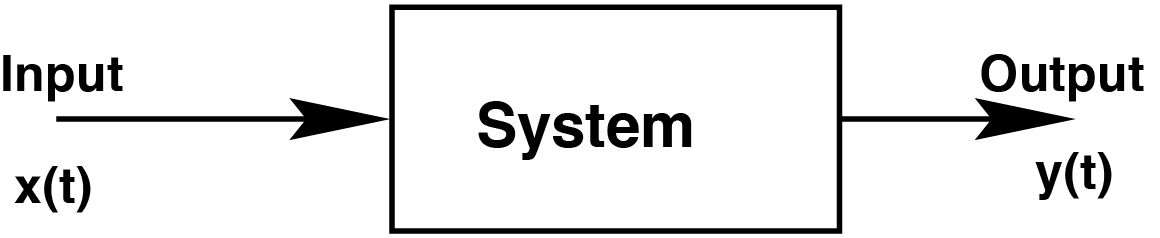
Fig. 1 A black-box representation: a system that transforms input signals into output signals.#
This course introduces methods for analyzing such systems in the domain of neuroscience. Our goal is to understand the principles behind system behavior rather than to memorize formulas. Throughout the course, we will apply these principles in simulations and experiments, for example, to model the saccadic eye movement system.
An Illustrative Example: The Spring-Mass System#
In physics, we can describe many systems using fundamental laws. Consider a mass suspended from a spring with stiffness \(K\), displaced by a distance \(D\) (Fig. 2). In the absence of friction, the position \(x(t)\) of the mass follows:
When friction (with coefficient (W)) is added, the motion becomes damped:
The damping term causes the oscillations to decay over time, resulting in a transient response.
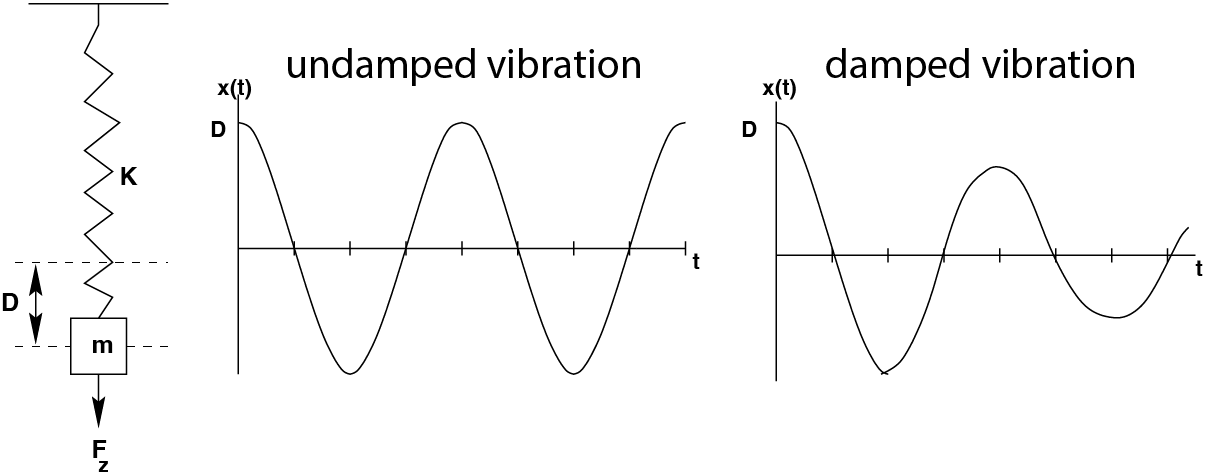
Fig. 2 A spring-mass system exhibiting undamped (top) and damped (bottom) oscillations.#
Systems analysis allows us to describe and predict the behavior of this mass-spring system without explicitly knowing its physical parameters or solving its differential equations.
Key insight
Systems Theory provides a more general description of a system’s behavior - one that does not depend on knowing the underlying physical mechanism or parameters.